Celebrating the Pillars of Our Faith
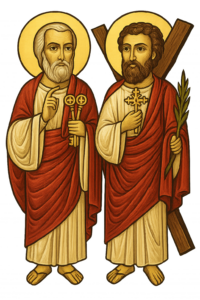
At St. Peter & St. Andrew Church, we honor the holy examples of Saint Peter and Saint Andrew. They exemplified unwavering faith, zeal, and the courage to follow Christ—even when the journey was difficult. Their lives continue to inspire us to trust in the Gospel, serve our community, and walk in the light of Christ.
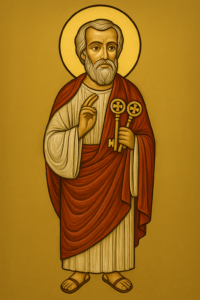
Saint Peter – The Rock of the Church
Names and Calling:
He has three names: Simon the son of Jonah, Cephas, and Peter. He and his brother Andrew were fishermen from Bethsaida. The Lord chose him on the second day after His baptism, following the selection of Andrew, his brother. Actually, Simon began his acquaintance with Christ through his brother Andrew. It is mentioned in the Gospel of John concerning Andrew: “He first found his own brother Simon, and said to him, ‘We have found the Messiah’ (which is translated, the Christ). And he brought him to Jesus. Now when Jesus looked at him, He said: ‘You are Simon the son of Jonah. You shall be called Cephas’ (which is translated, Peter, meaning a stone)” (John 1:40-42). We note that the three names appear in a single verse.
One of the Three Pillars
Simon Peter became the foremost name among the twelve apostles (Matt. 10:2). Indeed, he became one of three who were especially close to the Lord Christ: Peter, James, and John. These were the disciples whom Jesus took to the Mount of Transfiguration, where “His face shone like the sun, and His clothes became as white as the light” (Matt. 17:1-2), and they witnessed Moses and Elijah conversing with Him.
The Lord also took these three disciples with Him for the resurrection of Jairus’ daughter. The Gospel of Mark states: “And He permitted no one to follow Him except Peter, James, and John the brother of James” (Mark 5:37).
These three disciples accompanied Him as well to the Garden of Gethsemane during His agony before the crucifixion. The Gospel of Matthew says: “And He took with Him Peter and the two sons of Zebedee…” (Matt. 26:37).
Thus, Peter, James, and John had a special closeness with Christ. Therefore, the Apostle Paul recognized Peter as one of the three pillars of the early Church, stating: “And when James, Cephas, and John, who seemed to be pillars, perceived the grace that had been given to me, they gave me and Barnabas the right hand of fellowship, that we should go to the Gentiles and they to the circumcision” (Gal. 2:9).
Faith, Zeal, and Love
Saint Peter had fervent faith and strong zeal. When the Lord asked His disciples, “Who do men say that I am?” they answered, “Some say John the Baptist, some Elijah, and others Jeremiah or one of the prophets.” Simon Peter responded, “You are the Christ, the Son of the living God” (Matt. 16:13-20).
The Apostle Peter deeply loved the Lord Christ and His teachings. When some disciples turned back, Jesus asked the twelve, “Do you also want to go away?” Simon Peter replied, “Lord, to whom shall we go? You have the words of eternal life” (John 6:66-68).
His love was also demonstrated on Great Thursday night. When the Lord told His disciples, “All of you will be made to stumble because of Me this night,” Peter, with his characteristic impulsiveness, replied: “Even if all are made to stumble because of You, I will never be made to stumble… Even if I have to die with You, I will not deny You” (Matt. 26:31-35). “I am ready to go with You, both to prison and to death” (Luke 22:33).
A Weak Moment
Indeed, Saint Peter denied Christ three times during His trial. However, this denial was due to weakness, not a lack of love. Proof of this is that when the rooster crowed, “he went out and wept bitterly” (Matt. 26:75). Another proof is his response to the risen Lord: “You know that I love You” (John 21:17). The Lord accepted Peter’s repentance, reinstated him in his apostleship, and instructed him: “Feed My lambs,” and “Tend My sheep” (John 21:15-16).
His Preaching
After receiving the grace of the Holy Spirit, Peter traveled widely preaching Christ crucified, converting many to the faith. God performed numerous great signs and wonders through his hands. Peter also wrote two Catholic Epistles to the believers.
The Book of Acts describes how God worked extraordinary miracles through Peter, so much so that people carried the sick into the streets, hoping that Peter’s shadow might fall on them as he passed by, resulting in their healing (Acts 5:15).
The initial chapters of the Book of Acts primarily focus on Peter and John, detailing their foundational efforts in building the early Church before the ministry of the Apostle Paul began.
Peter’s strength in preaching is particularly evident in his sermon on the Day of Pentecost, which brought about three thousand people to faith, who were deeply moved and subsequently baptized (Acts 2:37). Likewise, his sermon following the healing of the lame man (Acts 3), and his courageous testimony before the Jewish chief priests demonstrate his boldness in expressing his faith.
Filled with the Bible’s Spirit
Peter was profoundly knowledgeable of the Scriptures, often quoting Psalms and prophetic texts in his powerful explanations. Notable examples include his commentary regarding Judas (Acts 1:16-20), his Pentecost sermon referencing the Prophet Joel (Acts 2:16-21), and his quotations from Psalms (Acts 2:24-30). Additionally, his sermon after healing the lame man included prophetic references (Acts 3:21-25).
His epistles also reflect the deep biblical spirit within him, characterized by sound interpretation and profound insight. He wrote: “knowing this first, that no prophecy of Scripture is of any private interpretation, for prophecy never came by the will of man, but holy men of God spoke as they were moved by the Holy Spirit” (2 Peter 1:20-21). Additionally, he reminded believers: “I stir up your pure minds by way of reminder, that you may be mindful of the words which were spoken before by the holy prophets” (2 Peter 3:1-2).
His Martyrdom
Upon arriving in Rome, Peter found Saint Paul the Apostle already preaching there. Their combined preaching efforts led many Romans to faith. Consequently, Emperor Nero arrested Peter and ordered him to be crucified. Peter requested to be crucified upside down, and thus he delivered his soul into the hands of the Lord.
Coptic Synaxarium:
On Abib 5th, Saint Peter was martyred. Peter was from Bethsaida and was a fisherman. The Lord chose him on the second day after His baptism, following His selection of Andrew, Peter’s brother. He possessed fervent faith and strong zeal, as demonstrated when he confessed Jesus as the Christ (Matt. 16:13-20). After receiving the Holy Spirit, Peter traveled extensively preaching Christ crucified, performing many miraculous signs, and converting numerous individuals. He authored two Catholic Epistles to believers. When Peter arrived in Rome and joined Saint Paul in preaching, their ministry led to many conversions. Emperor Nero seized Peter and commanded him to be crucified. Peter requested to be crucified upside down, and he surrendered his soul to the Lord.
(Source: “The Two Saints Peter and Paul” by H.H. Pope Shenouda and the Coptic Synaxarium)
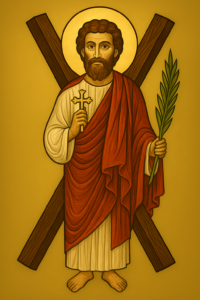
Saint Andrew the Apostle — known as the “Protokletos” or “First-Called” in the Byzantine Church
Scripture:
Matthew 4:18-20 | Matthew 10:2 | Mark 1:16-18 | Mark 1:29 | Mark 3:18 | Mark 13:3-4 | Luke 6:14 | John 1:35-44 | John 6:8-9 | John 12:20-22 | Acts 1:12-14
Commentary:
- Homily XIX of St. John Chrysostom on the Gospel of St. John 1:42-42
- Homily XX of St. John Chrysostom on the Gospel of St. John 1:43-44
- Synaxarium: The Martyrdom of St. Andrew the Apostle, the Brother of St. Peter
First Impressions & Observations:
St. Andrew was a simple fisherman who listened and acted immediately. He was one of the twelve disciples and was responsible for bringing St. Peter to Christ. Originally a disciple of St. John the Baptist, he followed Jesus after hearing St. John say, “Behold the Lamb of God!” When Jesus found St. Andrew and his brother fishing, He called them to be fishers of men, and they immediately left their nets and followed Him. St. Andrew was a man of action more than words, yet his actions brought about great fruits through St. Peter and set the stage for the miracle of the five loaves and two fish.
Outline of His Life:
- Fisherman in Bethsaida
- Disciple of St. John the Baptist
- Listened and followed Christ when John proclaimed, “Behold the Lamb of God!” (John 1:35-37)
- Immediately found his brother Peter to share the good news (John 1:41)
- One of the first called by Christ
- Christ invited Andrew and Peter to become “fishers of men” (Matthew 4:18-19, Mark 1:16-17)
- They immediately left their nets to follow Christ (Matthew 4:20, Mark 1:18)
- Chosen by Christ as one of the Twelve Disciples (Mark 3:18, Luke 6:14)
- Called by Christ to preach, heal sicknesses, and cast out demons (Mark 3:13-19)
- Suggested five loaves and two fish for feeding the five thousand (John 6:8-9)
- Did not yet fully understand Christ’s power, questioning, “but what are they among so many?” (John 6:9)
- Informed Jesus about Greeks who wanted to meet Him (John 12:20-22)
- Attended Upper Room prayer meeting and received the Holy Spirit (Acts 1:12-2:4)
General Insights:
- How quickly did he obey God when instructed?
- Immediately obeyed Christ’s call (Matthew 4:20, Mark 1:18)
- Occupation:
- Fisherman turned fisher of men
- Great accomplishments:
- Bringing St. Peter to Christ
- Crucial decisions and their impact:
- Leaving job security and familiarity to follow Christ, despite uncertainty
Character strengths:
- Desire to bring others to Christ
- Humility in operating behind the scenes (five loaves and two fish, informing Christ about Greeks)
- No jealousy toward St. Peter, even when Christ said to him, “on this rock I will build My church” (Matthew 16:18)
Development in character over time:
- Initially questioning at the miracle of the loaves, later confidently introducing Greeks to Christ, demonstrating spiritual growth
Long-term results of life and ministry:
- Instrumental in the addition of three thousand souls to the church on Pentecost by introducing St. Peter (Acts 2:41)
- Continued evangelizing and ministering to Gentiles, facing persecution and martyrdom
Character Qualities Identified:
- Loyalty (John 1:41)
- Obedience (Matthew 4:20, Mark 1:18)
- Discernment (John 1:35-37)
- Resourcefulness (John 6:8-9)
- Enthusiasm (John 1:41)
- Love (John 12:20-22)
- Zeal (John 12:20-22)
- Faith (Matthew 4:20, Mark 1:18)
- Humility (John 1:41)
Bible Truths Illustrated in His Life:
- Importance and urgency of preaching the gospel (1 Corinthians 9:16)
- Love must be demonstrated through action, not mere words (1 John 3:18)
- God chooses the simple who trust Him rather than the self-wise to reveal His truth (Matthew 11:25)
Summary of Lessons Learned:
The outstanding characteristics of St. Andrew included discernment, love, zeal, and obedience. Despite numerous false prophets during his time, St. Andrew discerned truth in St. John the Baptist and immediately followed Christ upon John’s declaration. His first act after recognizing Jesus as the Messiah was to share this revelation with his brother. He swiftly abandoned his livelihood to follow Christ without hesitation. Andrew exemplified urgency in sharing the Good News, willingly sacrificing the comfort of his former life to spread the Gospel immediately and effectively.
Personal Application:
Saint Andrew exemplified trust and prompt action. Often, I complicate God’s instructions, though He simply desires immediate obedience without questioning His plan. Unlike St. Andrew, I frequently lack urgency in sharing Christ due to laziness or shyness. As a result of this study, I commit to promptly obeying God’s instructions, trusting His perfect plan, and weekly reaching out to someone who does not know Christ, regardless of discomfort or awkwardness.
Transferable Concepts:
- Saint Andrew promptly followed Christ after hearing John the Baptist. Similarly, when God reveals truth, we must follow without delay.
- Saint Andrew immediately shared Christ with his brother after encountering Him. True zeal compels us to urgently share the Good News.
- Saint Andrew immediately responded to Christ’s call. Trusting Christ, we must promptly follow His instructions, regardless of how unusual they may appear.
- Saint Andrew provided five loaves and two fish for feeding five thousand. Even in seemingly impossible situations, we must trust God’s perfect solutions.
Study on St. Andrew the Apostle by Andrew Mitry
Synaxarium:
On Kiahk 4th, Saint Andrew the Apostle, brother of St. Peter, was martyred. He was appointed to evangelize in the city of Lydd and Kurdistan. Accompanied by his disciple Philemon, who possessed a beautiful voice and was an excellent reader, St. Andrew commanded him to read aloud.
When the idol priests learned of Andrew’s presence, they approached the church armed with spears, listening to detect blasphemy against their gods. Hearing Philemon read Psalm 115:4-8, their hearts softened. Entering the church, they prostrated before Andrew, believed in Christ, and were baptized along with other idolaters.
Andrew continued preaching in Kurdistan and cities like Aksis, Aregnas, and Henefores. Accompanied by St. Bartholomew, he also preached in Azrinos, converting many through miracles. Conspirators sought to kill Andrew but their messengers, touched by his teachings, believed instead. When unbelievers later attacked him, fire descended from heaven, terrifying and converting them.
Andrew’s fame spread, yet idol priests continued their persecution, eventually capturing and severely beating him. They imprisoned him, intending crucifixion. The Lord comforted Andrew in prison, strengthening him for martyrdom. The following day, he was hanged on a tree and stoned to death. Believers reverently buried his body, from which numerous miracles emerged.
May his prayers be with us, and glory be to our God forever. Amen.